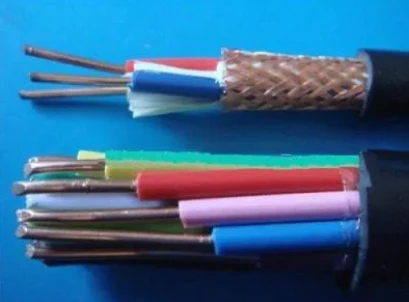
TPV Dynamic Vulcanization Line — Two-Stage (Two-Step) Compounding

TPV Dynamic Vulcanization Line — Two-Stage (Two-Step) Compounding

Nanjing Granuwel supplies turnkey TPV dynamic vulcanization lines, with the two-stage (two-step) configuration as our standard setup — from internal-mixer pre-compounding and multi-component gravimetric feeding, through co-rotating twin-screw reactive extrusion and vacuum devolatilization, to underwater pelletizing, dewatering, drying, screening and homogenization.

TPV (thermoplastic vulcanizate) is a thermoplastic elastomer produced by dynamic vulcanization: the rubber phase (typically EPDM, dispersed as particles of roughly 1–3 µm) is finely dispersed under shear into a continuous thermoplastic matrix (typically PP). The result combines rubber-like elasticity with the processability of plastics — extrudable, injection-moldable and recyclable. In industry, TPV is predominantly produced by the dynamic vulcanization route (physical-blending routes exist but are far less common); this page focuses on complete dynamic vulcanization lines.
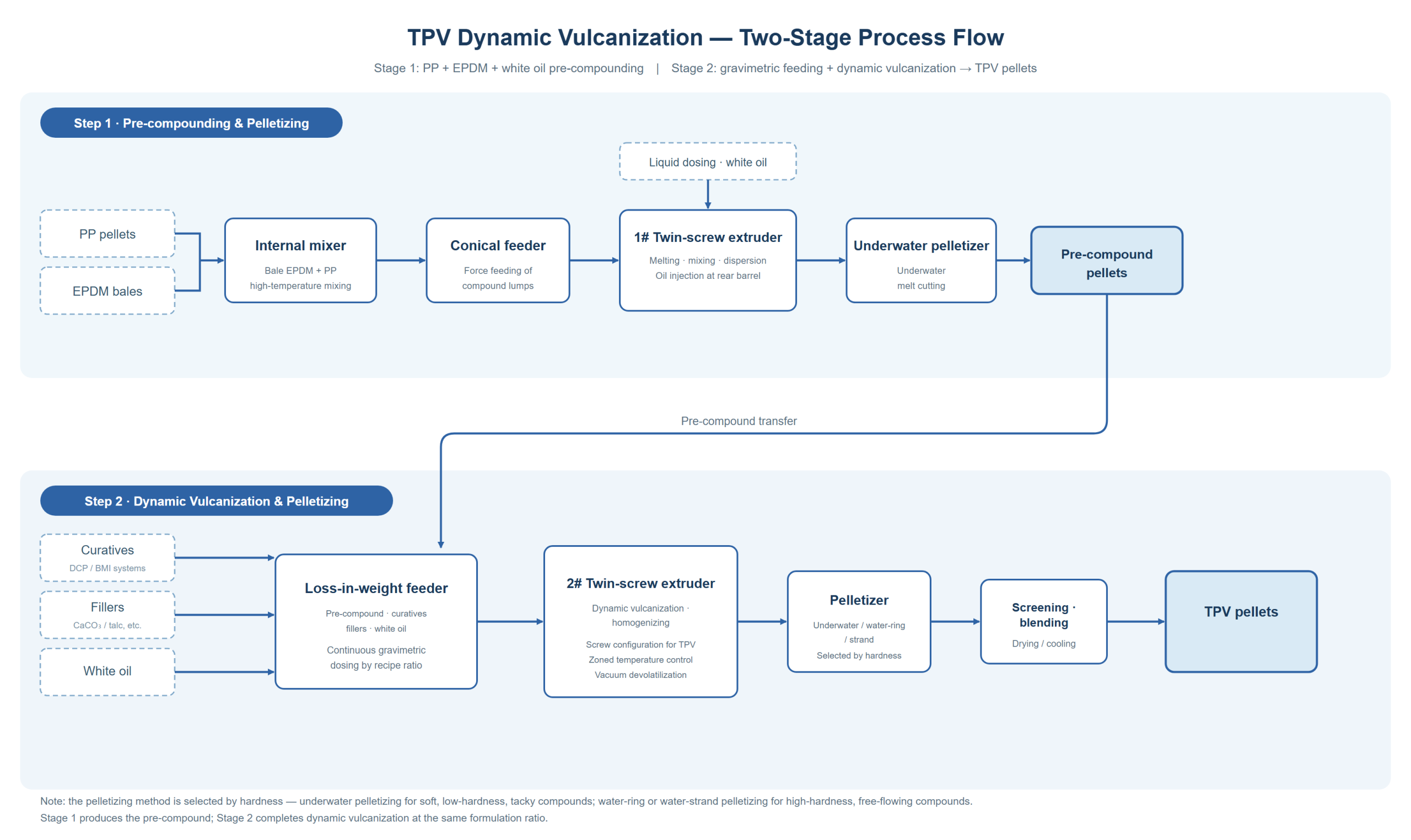
Two-stage TPV process flow showing pre-compounding and dynamic vulcanization
Nanjing Granuwel Machinery — TPV Two-Step Process Flow Diagram

Key process challenges in TPV dynamic vulcanization — and how our equipment solves them

Process challengeEquipment requirementGranuwel solution
The rubber phase must be broken down to a micrometer scale before gelation completes, or mechanical properties fall shortHigh shear and high load-bearing capacityHigh-torque gearbox (GTE-D series, T/A³ > 8) with 500–600 rpm speeds, plus modular screw configurations with shear / dispersion elements
Melting, vulcanization and homogenization zones need different temperatures, without oxidative degradationIndependently controlled barrel zones with tight temperature accuracyModular barrel with independent zone temperature control; bimetallic liners (45# steel base + A-101 alloy), C-type or integral liner options
Vulcanization needs sufficient residence time, but over-long residence causes degradationAdequate L/D ratio and screw configurations adjustable per formulationGTE series with L/D up to 68 and Do/Di 1.55; screws and barrels built on a modular principle, configurable to the recipe
Filling oil and curatives must be added stepwise at defined positions; charging a large oil quantity at once causes screw slipping and formulation driftMulti-stream loss-in-weight feeding plus multi-point staged liquid injection with accurate ratio controlMulti-component loss-in-weight feeding system (pellet / powder / liquid scales) + multi-point staged liquid injection to avoid local over-lubrication
Moisture and volatile by-products must be removed (automotive and cable customers are particularly sensitive to odor)Controllable vacuum vent position and vacuum levelVacuum devolatilization unit; vacuum level and vent position set per formulation

How the TPV formulation shapes the line configuration

a typical TPV consists of an EPDM rubber phase, a PP resin phase, filling oil, fillers and curatives / additives. The rubber-phase ratio varies widely with hardness grade — soft grades are rubber-rich, hard grades far less so. This is exactly why the two-stage (two-step) configuration is so adaptable: when the rubber ratio changes significantly, feeding in two steps is much easier to control than charging everything at once.
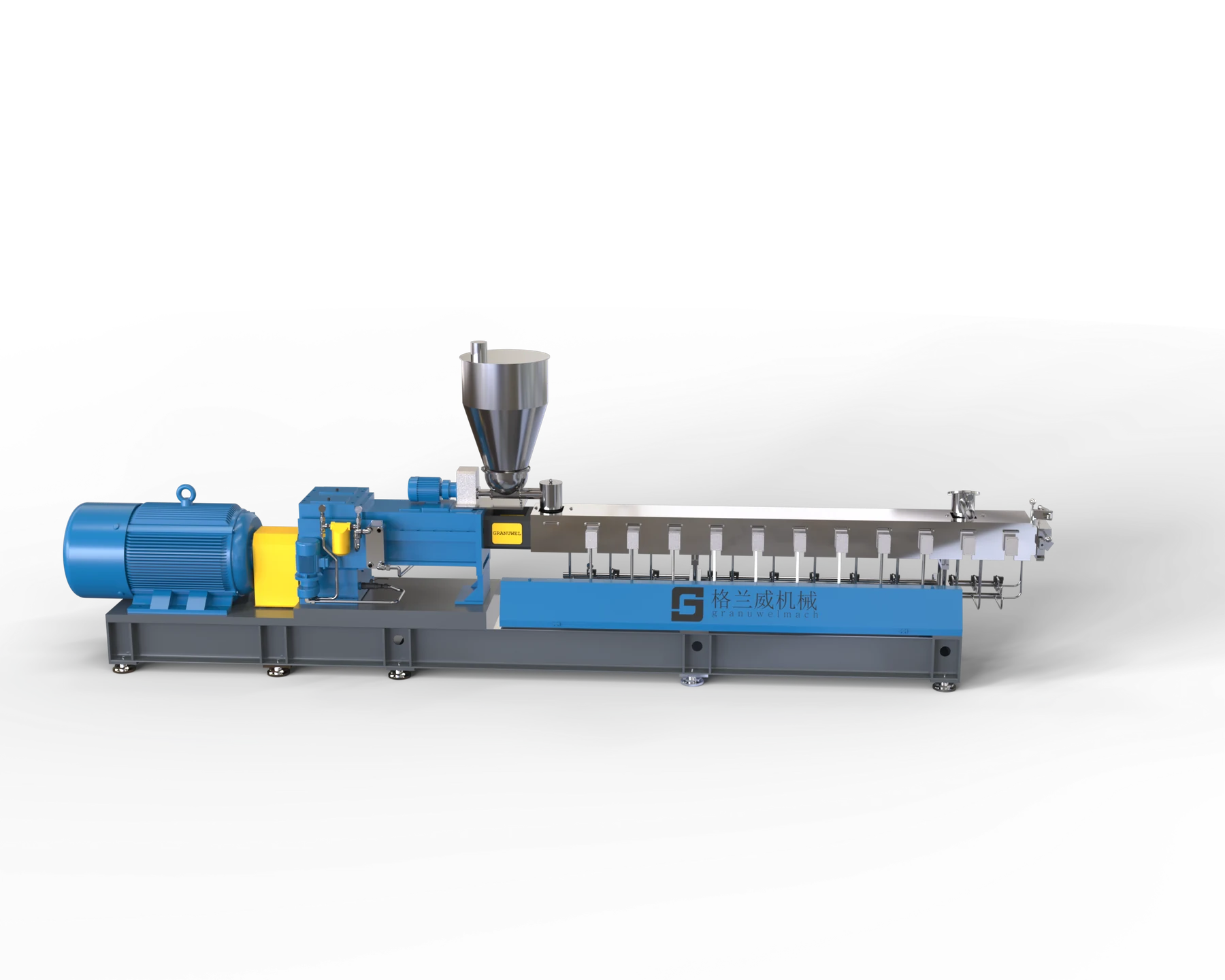
Granuwel GTE twin-screw extruder for TPV dynamic vulcanization
Nanjing Granuwel Machinery — GTE Twin-Screw Extruder

Key process window for reference:

ZoneTypical temperature
Melting / mixing zone160–200 °C
Dynamic vulcanization zone190–220 °C
Homogenization zone180–200 °C

Note: residence time in the vulcanization zone is typically 30–90 s depending on the formulation and target crosslink density; the vacuum vent typically operates at 50–200 mbar. Common curative systems are peroxides such as DCP, or phenolic-resin / bismaleimide (BMI) systems.
Why we recommend a two-stage (two-step) line

Granuwel standard configuration: the two-stage (two-step) line

Avantages : highly adaptable to formulation changes and start-up parameter tuning; moderate torque demand — a medium L/D ratio is sufficient; the same machine and screw configuration can also run TPE / TPR compounds; lower line investment. This is the most widely adopted and most mature configuration among TPV producers in China and worldwide.

Line composition: internal mixing / pre-compounding section + two GTE twin-screw extruders + pelletizing and downstream section.

The two-step process, step by step:

pre-compounding & pelletizing: typically PP + EPDM + white oil. As EPDM is usually supplied in bales, it is first kneaded together with PP in an internal mixer, then fed through a conical feeder into the twin-screw extruder; white oil is dosed proportionally by a liquid metering system at the rear barrel section, and the well-mixed melt is pelletized underwater to produce pre-compound pellets.

dynamic vulcanization & pelletizing: a loss-in-weight gravimetric feeder charges the pre-compound pellets together with curatives, fillers and white oil, in ratio, into the second twin-screw extruder, where melting, oil extension and dynamic vulcanization are completed to yield finished TPV pellets.

The alternative route: single-pass (one-step) lines — for reference

A single-pass configuration also exists in the industry: PP, EPDM, fillers, filling oil and curatives are charged at defined positions via multi-stream loss-in-weight feeding into one extra-long twin-screw extruder, completing melting → compounding → dynamic vulcanization → pelletizing in a single pass. It offers lower energy and labor consumption per ton and fully enclosed continuous production, but requires an extra-long L/D ratio (approx. 56–68), a high-torque gearbox, multi-stream loss-in-weight feeding and a melt pump; line investment is significantly higher, equipment versatility is limited and the process window is narrow. It only pays off when the formulation is fully mature and a single grade is produced in very large volumes.

Two-stage vs single-pass at a glance:

ItemTwo-stage line (Granuwel standard configuration)Single-pass line
Feeding modeSecondary feeding after pre-compound pelletizingAll components charged in one pass
L/D ratio requirementMediumExtra-long (approx. 56–68)
Torque demandModerateHigh (high-torque gearbox required)
Adaptability to formulation changesStrongNarrow
Can also run TPE / TPRYes, with little screw changeNot well suited
InvestmentLowerSignificantly higher
Best suited forMultiple grades, frequent formulation tuning, newcomers to TPVMature formulation, single grade, very large volumes

Granuwel recommends and mainly supplies the two-stage (two-step) configuration. For most TPV production scenarios it offers the best overall balance of formulation adaptability, investment threshold and equipment versatility. Our engineers will confirm the pre-compounding section and twin-screw configuration based on your formulation and capacity plan.

What the complete line includes

Equipment moduleFunctionStandard / Optional
Mélangeur internePre-compounding of bale EPDM with PP (step 1 of the two-step process)Standard in two-step configuration
Horizontal / high-speed mixerPre-mixing and oil absorption of pellet-form EPDMOptional (for pellet-form feed)
Multi-component loss-in-weight feeding system (pellet / powder / liquid scales)Accurate ratio control of all componentsStandard
Conical feederForced feeding of internal-mixer lumps into the twin screwStandard in two-step configuration
GTE series co-rotating twin-screw extruder (high-torque type)Melting, compounding, dynamic vulcanizationStandard
Side feederSide feeding of fillers, glass fibers and similar materialsOptional
Multi-point staged liquid injection systemPosition-controlled staged injection of white oilStandard
Vacuum devolatilization unitRemoval of moisture and volatile by-productsStandard
Screen changer / melt pumpPressure stabilization before pelletizing, reduced melt-temperature fluctuationOptional
Pelletiseur sous-marinSoft, low-hardness, tacky gradesStandard
Water-ring pelletizer / water-cooled strand pelletizerHigh-hardness, free-flowing gradesOptional
Centrifugal dewaterer + drying systemPellet dewatering and dryingStandard
Tamis vibrantRemoval of overlong / oversize pellets for uniform granule sizeStandard
Homogenizing / drying siloBatch-to-batch uniformityOptional
Silos / bulk-bag packingFinished-product packingOptional

Why a co-rotating twin screw for TPV — what our equipment is built on

High-torque gearbox:

TPV melts are strong and highly loaded. The GTE-D series is a high-speed, high-torque design (T/A³ > 8), delivering continuous high torque even at low screw speeds to withstand the heavy load of the dynamic vulcanization section.

Modular screws and barrels:

screw elements and shafts connect via involute splines; the intermeshing profile is self-cleaning; elements are interchangeable and the configuration is adjusted to the recipe.

Bimetallic barrels:

barrel base in 45# steel with an A-101 alloy liner; C-type liners or integral liners available. Modular design — a single worn barrel section can be replaced without scrapping the whole set.

Zoned, precise temperature control:

melting, dynamic vulcanization and homogenization zones are controlled independently, preventing local overheating and degradation of either phase.

Multi-stream metering + staged liquid injection:

pellets, powders and liquids are metered separately and added at defined positions, avoiding screw slipping and formulation drift caused by charging all the oil at once.

Vacuum devolatilization:

removes moisture and volatiles and lowers pellet odor — automotive sealing and cable-jacket customers are especially sensitive to this.

Pelletizing matched to melt behavior:

soft, low-hardness, tacky grades run on underwater pelletizing; high-hardness, free-flowing grades on water-ring or water-cooled strand pelletizing.

Where TPV is used

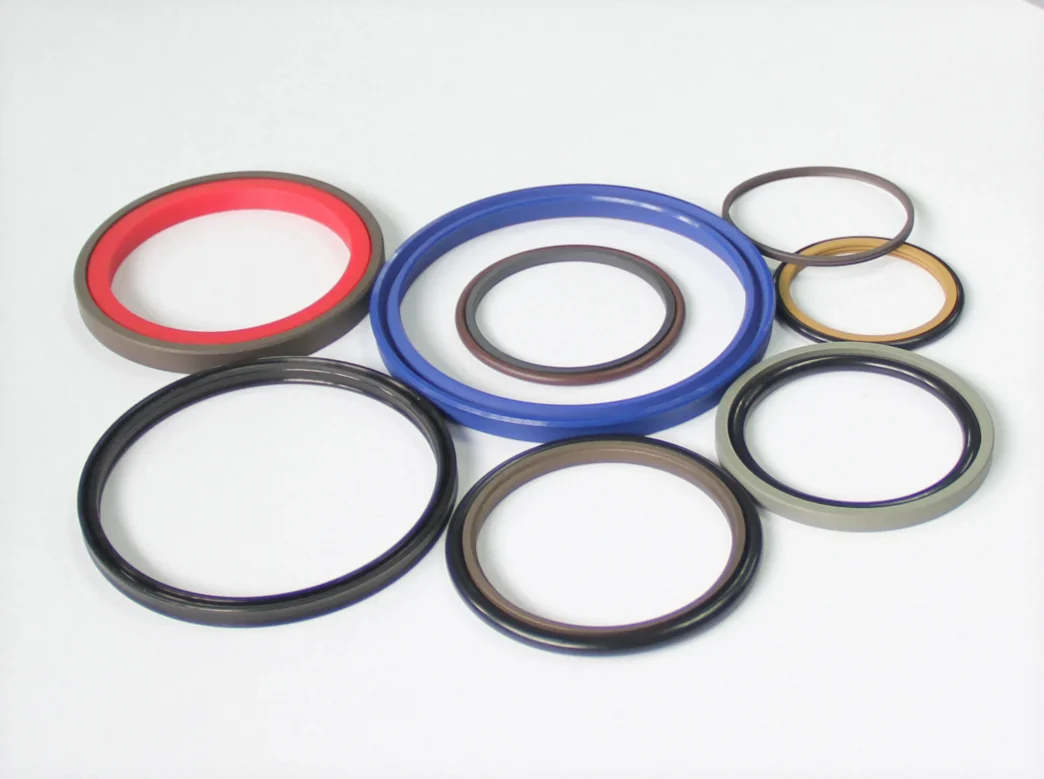
In automotive sealing in particular, TPV (PP/EPDM) is progressively replacing conventional cured EPDM — higher production efficiency, lower equipment and labor investment, and lighter parts.

FAQ

The two-stage configuration offers the strongest adaptability to formulation changes and start-up tuning, covers both soft and hard grades across wide rubber/resin ratios, can also run TPE / TPR blends on the same screw set, and requires lower line investment — which is why it is the most widely adopted route among TPV producers worldwide. Granuwel mainly supplies two-stage (two-step) lines.

Yes. A two-stage line usually runs TPE / TPR compounds with only minor adjustments to the screw set and feeding settings.

Yes. EPDM is mostly supplied in bales and must first be kneaded with PP in an internal mixer into a pre-compound, which then enters the twin screw through a conical feeder; pellet-form EPDM can go straight into a mixer for pre-blending. We design the upstream section around your feed form.

Soft, low-viscosity, tacky grades are typically pelletized underwater; high-hardness, free-flowing grades on water-ring or water-cooled strand pelletizers. We configure this around your specific grades.

Turnkey — process design and screw configuration, equipment manufacturing, installation and commissioning, and operator training. Our equipment has been exported to more than 30 countries.

Yes. You can start with a lab / small-batch line to develop the formulation, then scale up to a production-size model once the recipe is fixed.

Get a TPV line proposal and quotation

Send us your TPV formulation, target throughput, hardness range and EPDM feed form. Our engineers will provide a two-stage line layout, screw configuration recommendations and a complete equipment quotation.

Formulaire de demande

Remplissez le formulaire ci-dessous pour nous contacter et vous recevrez une réponse de notre part dans les 12 heures.

Nous utilisons des cookies pour activer toutes les fonctionnalités afin d'optimiser les performances lors de votre visite et pour améliorer nos services en nous donnant un aperçu de la façon dont le site Web est utilisé. La poursuite de l'utilisation de notre site Internet sans avoir modifié les paramètres de votre navigateur confirme votre acceptation de ces cookies. Pour plus de détails, veuillez consulter notre politique de confidentialité.