Français
 English
 العربية
 Deutsch
 Русский
 Español
 한국어

Table des matières
BasculerIntroduction: Additive Masterbatch Production Line
A flame-retardant pellet can look acceptable and still fail its intended application. When specifying an additive masterbatch production line, start with the additive grade, carrier resin, and final fire-performance requirement. A configuration that handles calcium carbonate successfully may overheat, under-disperse, or contaminate a different FR formulation.
What Makes FR Compounding Unique
Flame‑retardant additives fall into distinct processing families. Brominated‑antimony, mineral‑hydroxide, and phosphorus‑nitrogen formulations each impose unique requirements for temperature, mixing and equipment metallurgy. Always reference the exact product grade and supplier datasheets, rather than relying only on general‑category descriptions.
Four key risk areas require evaluation: additive thermal degradation & discoloration, reduced toughness at high loadings, moisture‑/volatile‑induced defects, and abrasive wear plus chemical corrosion. Not every FR formulation triggers all four issues; severity depends on the full recipe.
| FR family | Processing distinction | What to confirm before a trial |
|---|---|---|
| Brominated package with antimony synergist | Thermal stability and decomposition products depend on the grade | Approved melt window and compatibility with wetted equipment materials |
| ATH-based mineral package | Decomposition releases water; temperature exposure must be controlled | Grade-specific thermal limit, loading and carrier compatibility |
| MDH-based mineral package | Offers a different thermal window from ATH | Actual additive/resin processing window and dispersion requirements |
| Phosphorus/nitrogen package | Moisture behavior, chemistry and heat sensitivity vary by grade | Supplier drying instructions, stability and synergist ratios |
ATH and MDH release water when they thermally decompose as part of their flame-retardant mechanism. Huber's wire-and-cable additive brochure illustrates decomposition around 220°C for ATH and 330°C for MDH. These are reference observations, not recommended extrusion setpoints.
Mechanical shear can drive real melt temperatures above barrel set‑points. Define your safe operating window for the specific additive‑resin pair and validate it via trials. Brominated and phosphorus‑nitrogen systems also need grade‑specific thermal boundaries; no universal safe processing temperature applies for these groups.
Raw Material Pre-Treatment and Feeding
Once additives degrade inside the extruder barrel, the FR line cannot reverse this damage. Drying, venting and temperature control solve separate issues; higher vacuum cannot compensate for an improper melt‑temperature operating window.
Test incoming moisture with valid methods. Dry materials only following supplier‑approved parameters — over‑drying may damage additives or surface coatings. Deploy sealed material transfer and avoid leaving bags open between shifts. On multi‑component lines, deploy individual loss‑in‑weight feeders sized for minimum stable feed rate, not just nominal throughput.
Pre‑blending eases handling yet risks composition segregation during transfer. Validate the full material path from bag/silo to extruder, do not qualify feeders using substitute test materials.
Before commissioning an additive masterbatch production line, collect these documents & specifications:
- SDS and technical datasheets for all additives plus carrier resin
- Allowed processing ranges, drying rules and material incompatibilities
- Concentrate loading, let‑down ratio and target end‑product thickness
- Mandated dispersion, mechanical, color and fire‑performance requirements
- Regional regulatory declarations and project‑specific customer constraints
Screw & Barrel: Wear and Corrosion Protection
| Exposure or duty | Component specification to discuss | Evidence to request |
|---|---|---|
| Abrasive mineral loading | Wear-resistant elements and suitable barrel liners | Material grade, treatment, working-layer details and inspection limits |
| Chemically aggressive formulation | Chemically compatible alloy or liner system | Compatibility rationale for the actual formulation and temperature |
| Combined wear and corrosion | A matched element and barrel material pair | Supplier assessment of both damage modes and repair options |
| Frequent recipe changes | Accessible modular sections and effective cleaning | Disassembly procedure, purge validation and spare-part identification |
Granuwel's core-component selection guide covers elements, barrels and drive components. For an FR project, add the actual alloy specification and replacement criteria to the quotation rather than accepting only “bimetallic” or “wear resistant.”

The line should also allow baseline clearance measurements. Repeatable inspections help distinguish normal abrasion from local corrosion or damage caused by an unsuitable operating condition.

Melting, Dispersion and Devolatilization
A co‑rotating twin‑screw extruder must wet and distribute additives while minimizing thermal exposure. Insufficient mixing causes agglomerates; over‑intensive mixing elevates melt temperature and triggers degradation.
Run trials with validated screw layouts and stable feed rates, logging melt temperature, torque, barrel pressure and throughput. “Low temperature and short residence time” is only a process target, not a formal specification.
Vacuum venting requires proper upstream melt sealing to limit powder carry‑over. Additional vacuum ports do not automatically deliver better results; match vent stages to real volatile loading, and equip condensate traps & cleaning access for high‑volatile formulations.
Our filler-masterbatch processing overview covers high‑solids processing basics. FR‑system qualification adds chemistry‑specific checks for temperature, contamination and final part performance. For recurring gas defects, troubleshoot moisture, decomposition and melt‑sealing as independent root causes.
Pelletizing Selection for FR Masterbatch
Requirements for FR Pellets: Dense & Bubble-Free
For the additive masterbatch production line acceptance test, inspect pellet cross-sections as well as the exterior. Agree on moisture, fines, agglomerates and internal-void limits using defined sampling methods.
A dense pellet with no visible internal voids is a useful acceptance goal, but specify the sampling method and inspection sensitivity. Also check pellet-size distribution, fines and agglomerates. Smooth external surfaces alone cannot establish that the interior is free of bubbles.
Rapid Cooling for Heat-Sensitive FR Materials
On an additive masterbatch production line, air-cooled strands avoid direct water contact and may suit formulations where water exposure is undesirable. They still need sufficient strand strength, cooling capacity and manageable dust. See Granuwel's air-cooled strand pelletizer configuration for the equipment arrangement.
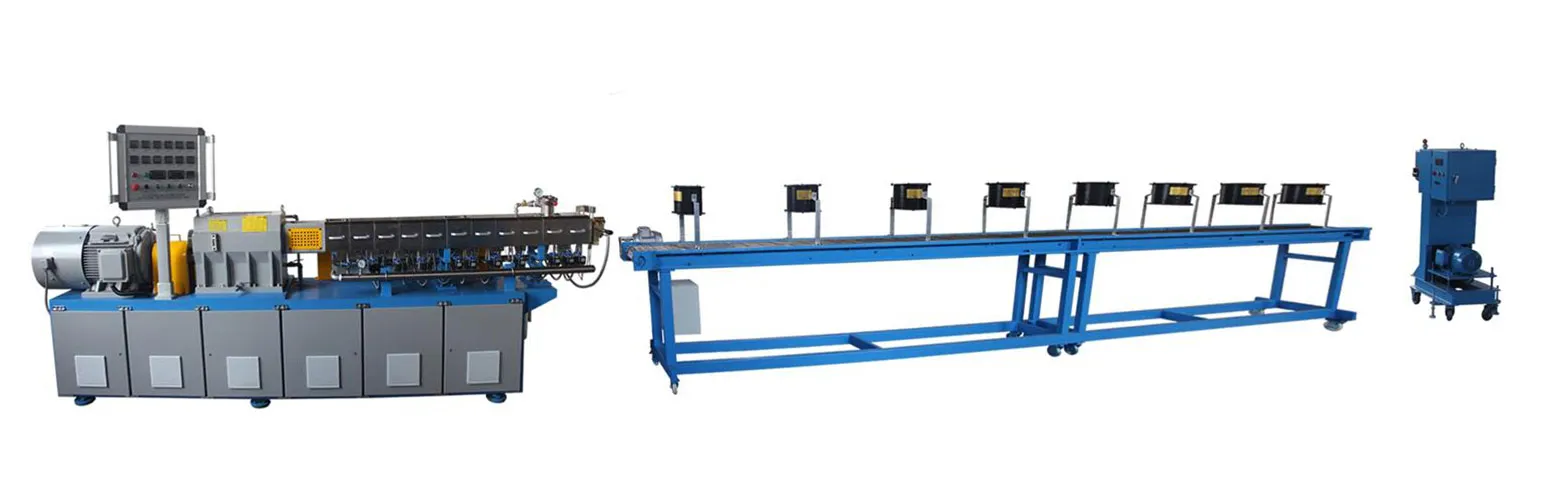
Water-ring cutting may suit other formulations, but it requires confirmation of cut quality, sticking, water compatibility and drying performance. Rapid surface cooling cannot remove gas already trapped in the melt, and air cooling does not automatically cool every formulation faster than water.
Quality Inspection & Defect Troubleshooting
| Defect | Possible causes | First checks |
|---|---|---|
| Bubbles or silver streaking in downstream plaques | Moisture, volatiles, decomposition or ineffective venting | Measure moisture; compare melt temperature and vent performance |
| Brittle pellets or molded samples | Excess loading, poor compatibility, degradation or weak dispersion | Verify formulation and carrier, then test dispersion and mechanical properties |
| Black specks or discoloration | Hold-up, contamination, local overheating or additive breakdown | Inspect retained material and temperature history; validate cleaning |
| Uneven additive distribution | Feeder variation, agglomeration or insufficient incorporation | Check dosing trends and sample dispersion before increasing shear |
An additive masterbatch production line should retain the process history associated with each sample. Otherwise, a failed laboratory result is difficult to connect to a refill event, temperature excursion or recipe transition.
Check pellet appearance, moisture, dispersion and composition, then test the let-down compound at the specified formulation and thickness. UL's plastics-recognition terminology identifies both flame class and minimum thickness. A masterbatch or machine purchase does not establish a universal UL 94 rating for every finished article.
When comparing an additive masterbatch production line from an overseas manufacturer, include the following in the technical agreement:
- A factory trial using representative ingredients, including start-up and a recipe change.
- Guaranteed acceptance conditions tied to the recipe, output and agreed laboratory tests.
- The site's voltage, frequency, cooling-water conditions and extraction requirements.
- Destination-specific machine documentation; a CE claim does not certify the pellets' fire performance.
- Protected sea-freight packaging, a commissioning plan, wear-part drawings and an agreed overseas support route.
Granuwel lists GTE-B, GTE-C and GTE-D twin-screw extruder series, alongside separate feeding equipment and pelletizing options. These form a starting point for an additive masterbatch production line; an FR-compatible configuration still needs a recipe-specific technical agreement.
FAQ
An additive masterbatch production line may handle both if materials compatibility, cleaning and carryover limits are validated. Customer restrictions or difficult-to-clean deposits may make dedicated equipment preferable.
No. Additional loading can reduce mechanical performance or upset a synergistic package. Validate the final formulation rather than increasing concentration by assumption.
Surface chemistry, particle treatment, storage and exposure affect moisture pickup. Different grades behave differently; use supplier guidance and measurements.
Match alloys to the formulation, avoid damaging process excursions and inspect defined wear points. Track wear against processed material and operating conditions, rather than calendar time alone.
Conclusion
A qualified additive masterbatch production line for flame-retardant compounds must match the equipment design to your additive chemistry: precision feeding, anti-corrosion & wear parts, controlled melting, devolatilization and pellet cooling. Final acceptance should be based on full-scale trials and end-product fire tests, with full formulation and test records kept.